THE INTERACTIVE TEXTBOOK
Introduction to
Quantum Computing 2026
From the first complex amplitude to reliable quantum computation.
A mathematical course you can read, question, and experiment with. Begin with ordinary algebra; build toward quantum information, algorithms, noise, and fault tolerance.
START WITH A QUESTION
One state. Three measurement bases.
For (2|0⟩ + 3i|1⟩)/√13, the Z, X, and Y bases reveal different probabilities. Change the amplitudes, sample measurements, and unfold every inner product.
Open the projection workbench →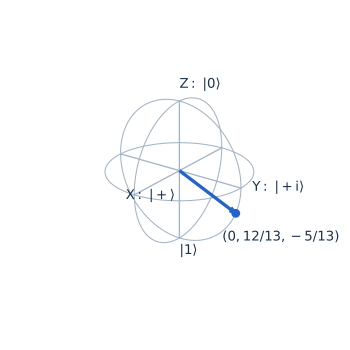
A continuous course
Each chapter has the same explanations, examples, notation, and exercises in the PDF and on this site. Laboratory links take you directly from the page to the experiment.
CHAPTERS 1–8
Build the foundations
Probability, amplitudes, measurement, circuits, entanglement, and open systems.
- Information, probability, and computation
- Complex amplitudes and quantum states
- Measurement and changes of basis
- Gates, observables, and the Bloch sphere
- Registers, circuits, and entanglement
- Density matrices and subsystems
- Bell correlations, teleportation, and dense coding
- Noise channels, measurement data, and mitigation
CHAPTERS 9–15
Understand the algorithms
Oracle interference, period finding, Fourier methods, Hamiltonian simulation, and variational techniques.
- Oracle algorithms: Deutsch, Deutsch–Jozsa, and Bernstein–Vazirani
- Simon's algorithm and hidden XOR structure
- Grover search and amplitude amplification
- Fourier transforms and phase estimation
- Period finding and Shor's factoring algorithm
- Hamiltonian simulation and modern algorithmic tools
- Variational algorithms and their limits
CHAPTERS 16–20
Make computation reliable
Classical simulation, stabilizer codes, decoding, logical operations, and resource budgets.
CHAPTERS 21–25
Connect theory to practice
Physical platforms, quantum networks, reproducible software, 2026 evidence, and integrated projects.
A dated view of a changing field
Research cutoff: 5 September 2026. Experiments, theory, preprints, and company claims are identified separately. Hardware counts and resource estimates keep their assumptions and scope.
Read the scientific snapshot →